SENSIML · EDGE AI · ANALYTICS STUDIO
CASE STUDY · 2026
SensiML Agent solves PhD‑level ML problems in one conversation.
We built an AI agent inside SensiML Analytics Studio that takes an edge‑ML project from raw data to compiled model firmware, with Senior Data Scientist guidance on a 5% frontier / 95% basic model budget.
- Client
- QuickLogic
- Industry
- Semiconductor · Edge AI · TinyML tooling
- Product
- SensiML Agent · inside Analytics Studio
- Services
- AI agent development · LLM architecture · AWS deployment
- Year
- 2026
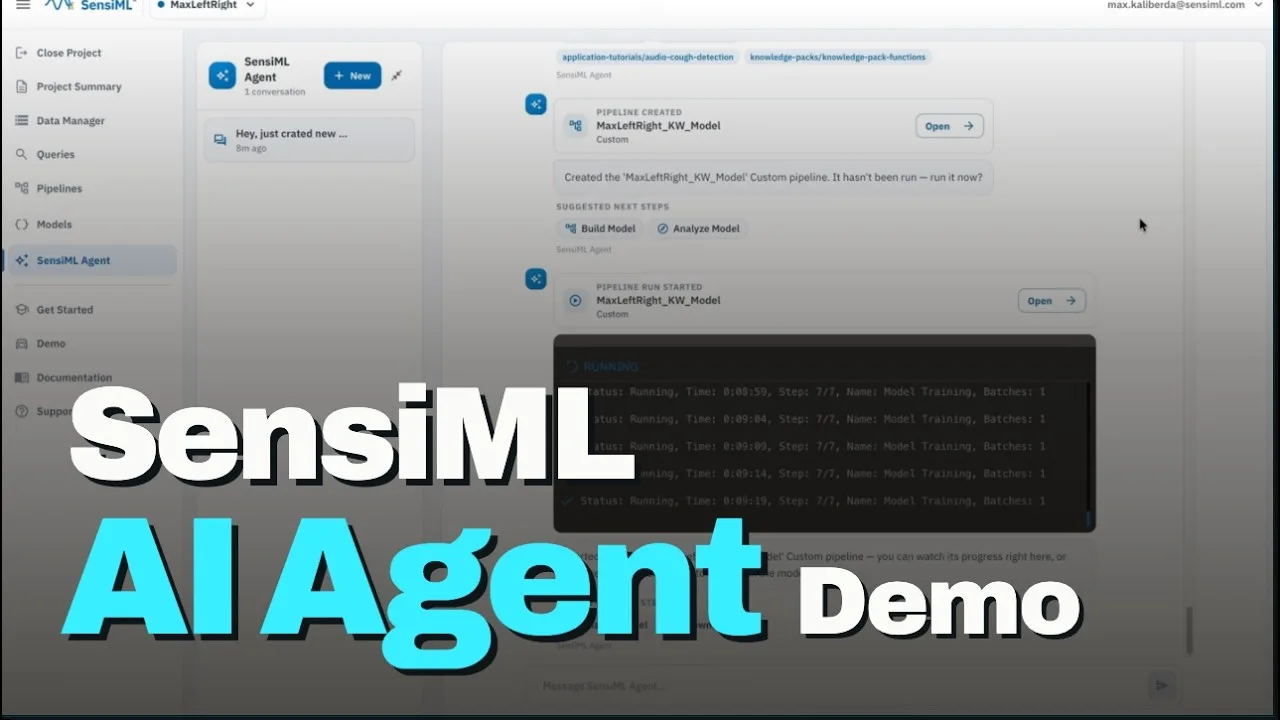
DEMO · KEYWORD SPOTTING · EMPTY PROJECT TO FIRMWARE OPEN ON YOUTUBE →
01 · PROJECT GOALS
Challenges & Goals
A chain of research-grade decisions. Building a model for an edge device is a sequence of hard choices, and each one has to be analyzed before the next is made.
Senior Data Scientist guidance on every turn
Every reply inspects the current project state and ends with a recommendation and a next step
The learning curve. Capture, label, query, build, compile: each step has its own techniques and practices, and learning them takes time before a first model ships.
Cover the whole workflow, end to end
From an empty project to a compiled Knowledge Pack in one conversation, with new steps added as skills
Knowledge locked in documentation. SensiML's docs, use cases and application examples are well structured, but the answer is rarely where the user is working.
Grounded answers inside the product
How-to questions answered from the SensiML documentation, citing only the chunks actually retrieved
Frontier cost. Senior-level guidance on every turn at frontier prices does not fit a product budget.
Senior guidance on a basic-tier budget
5% frontier (Fable) / 95% basic (Haiku): one small planning decision per turn on the frontier model, the work on the basic model
Trust. An LLM must never change a project on its own; every change has to stay in the user's hands.
The agent proposes, the user finalizes
Every change ends in a form the user edits and confirms; the backend runs it through the same code the UI uses
Fit inside the product and the cloud. A chat that lives beside Analytics Studio, or blocks on long jobs, would not be used.
A native part of Analytics Studio
Studio's own components rendered in chat, one-click next steps, training and firmware builds as background jobs, no new compute tier on AWS
04 · WHAT SHIPPED
Achievements
- 01
Senior Data Scientist guidance on a 5% frontier / 95% basic model budget.
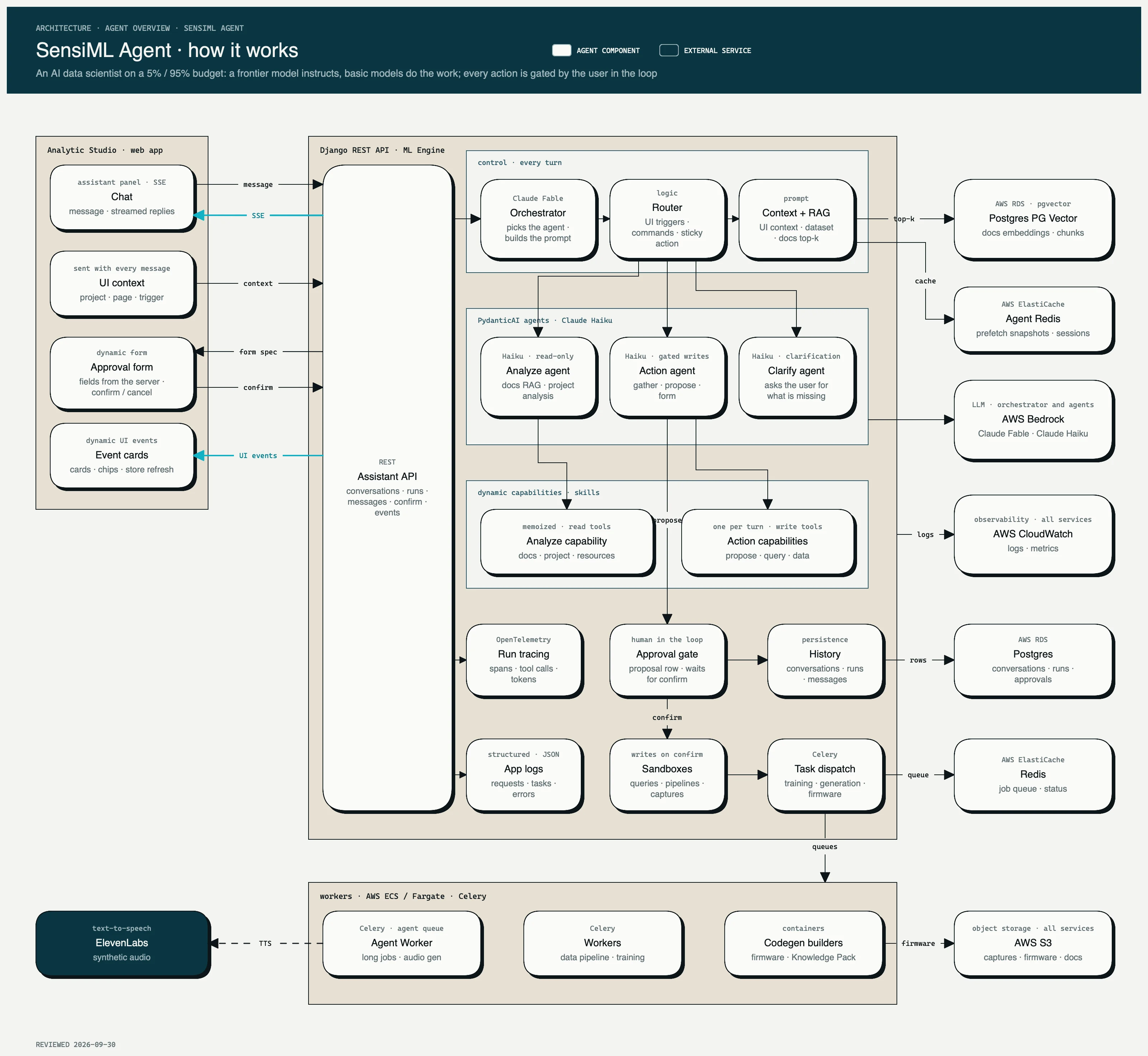
A frontier model (Claude Fable) makes one small decision per turn: intent, action, brief. A basic model (Claude Haiku) does the work from an assembled prompt: project state, retrieved documentation, tool rules. Every turn loads only the tools it needs.
- 02
The whole ML workflow, end to end.
Project setup, data generation and labeling, queries, model building and analysis, firmware download. From an empty project to a compiled Knowledge Pack in one conversation, with new steps added as skills.
- 03
An analyst on every turn.
Read-only analysis is always on: it inspects captures, queries, pipelines and built models, reads run logs to diagnose a failed build and proposes a fix, and answers how-to questions from the SensiML documentation with citations. Every reply ends with a recommendation and the next step.
- 04
The agent proposes, the user finalizes.
The LLM never writes. Every change ends in a form the user edits and confirms; the backend then runs it through the same code the UI uses.
- 05
Dynamic UI with the product's own components.
Fifteen events map to nine cards: charts, confusion matrices, build consoles, capture tables with playback, firmware downloads. Cards persist and re-render on reload, and every reply ends with one to three suggested next steps the user can take in one click.
- 06
Long work never blocks.
Audio generation, training and firmware builds run as scalable background jobs. The chat polls and the result lands when the work does.
- 07
Budget and governance built in.
Token and request limits on every run with a hard stop, approval and audit records for every change, secrets kept out of model context, errors shown as errors.
- 08
Cloud-ready and tested.
One setting switches between the Anthropic API and Amazon Bedrock, no stored keys. 281 server tests and 112 UI tests run offline; the system is documented as five diagram families generated from code.
05 · UNDER THE HOOD
Technical notes
Grounding, planning, skills, memory, budget, governance, provider, async, observability, tests.
-
Grounded answers
The full SensiML documentation is chunked and embedded once and stored in Postgres with pgvector; the top-k chunks are ranked at query time, and the agent may cite only the chunks it actually retrieved. Project state (dataset summary, captures, queries, pipelines, models, catalogs, the last build failure) is prefetched and cached in a dedicated Agent Redis before the model speaks, so model calls go to acting, not to looking things up.
-
Planning on the frontier tier
Claude Fable is the orchestrator. Once per turn it reads the recent conversation, the UI context and the project state, decides whether to analyze, act or ask, picks the capabilities the turn needs, and writes a short brief for the worker. One structured call, capped at 256 output tokens. UI triggers and imperative commands bypass it and route by rule; a regex fallback keeps routing working offline.
-
Skills loaded per turn
Each action is a self-contained skill: instructions, inspect and propose tools, prefetch, routing description. The worker gets the analysis tools every turn and exactly one skill when the plan names an action, so the toolset scales up and down with the task. A new action is one registration.
-
Durable memory
Conversations, runs, messages and approvals live in Postgres on RDS; tool calls and returns round-trip with them. Recent turns load verbatim, older turns as a summary. A thread stays attached to its project.
-
Budget on every run
Token and request caps are checked before each step and enforced mid-run. Over budget, the run fails with a stated reason and a logged budget_kill event; there is no best-effort continuation.
-
Governance
Approval and audit rows for every change, idempotent confirms scoped to the run, secrets never in model context or logs, trace rows excluded from history, failures persisted as error messages.
-
Provider independence
One setting switches between the Anthropic API and Claude on Amazon Bedrock (SigV4 from the instance role, no stored key). Model ids stay first-party. The keys that do exist, for text-to-speech and the optional Anthropic API, sit in Secrets Manager.
-
Async by default
Audio generation, training and firmware builds go to Celery queues on Redis and run on ECS / Fargate workers; firmware comes from the same Codegen builders as the Download page. The run parks, the chat polls, the reply lands when the job does. Resilient to worker recycles.
-
Observability
Structured event rows per turn (route, step, tools, confirm, reply, error, budget kill), CloudWatch logs and metrics alongside the rest of the platform, and Logfire / OpenTelemetry spans for every run. Three sinks, none of them dev-only.
-
Tested and documented as code
281 server tests across 25 modules, offline by default, plus an opt-in live gate; 112 UI tests across cards, forms, next-step buttons, dock, events and storage. Five diagram families regenerated from Python with the HyTyde Excalidraw Diagram System, an AWS deployment summary and a 13-step walk-through of one turn.
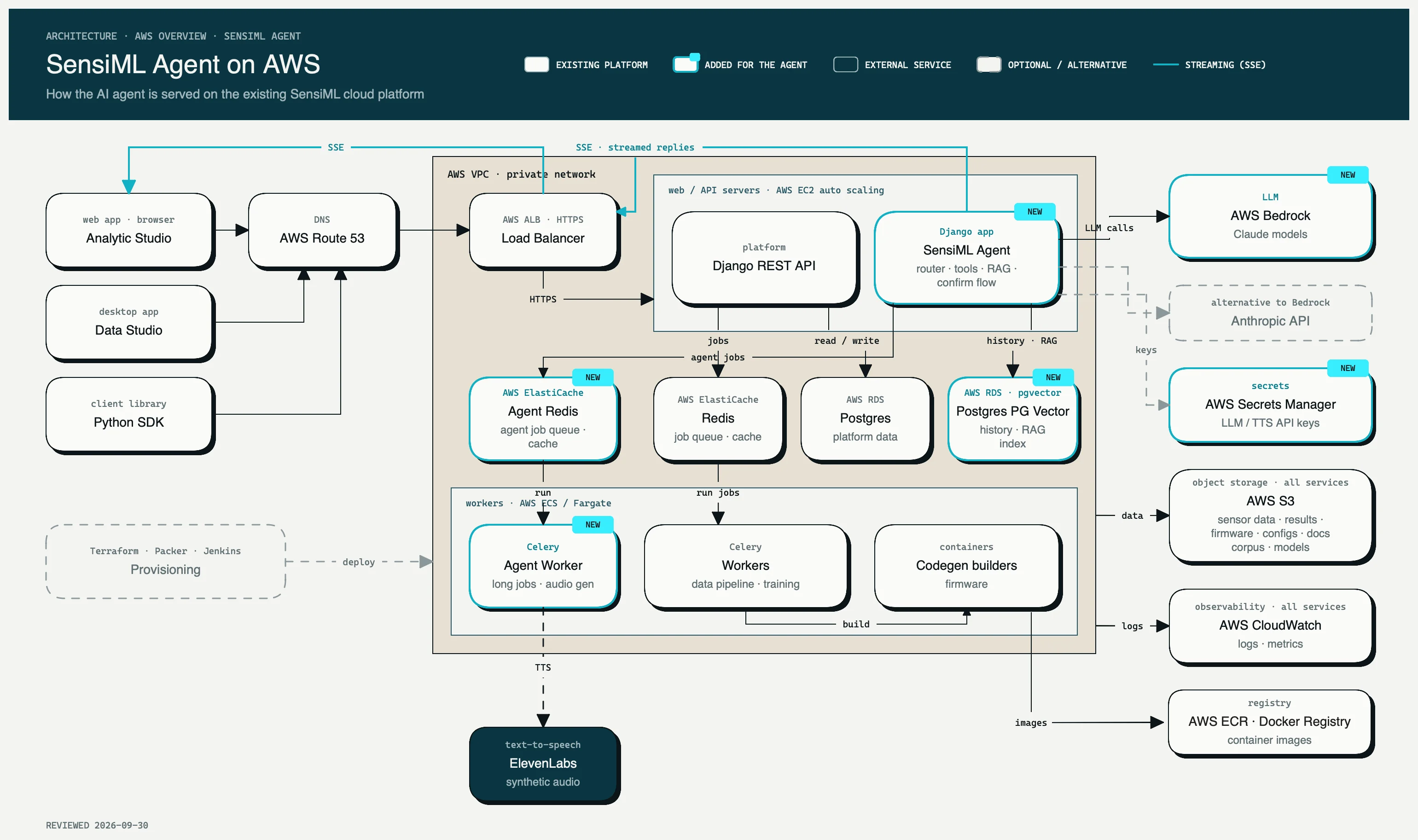
No new compute tier. The agent is a Django app on the existing API servers; what was added is managed: Amazon Bedrock, Secrets Manager, new RDS tables, one external egress to ElevenLabs.
06 · TECH STACK & INTEGRATIONS
-
 Claude Fable · Haiku Planner · worker
-
 Amazon Bedrock Model provider
-
 Django · PydanticAI Agent backend · agents
-
 React · SSE Assistant panel · streamed replies
-
 Celery · Redis Async jobs · cache
-
 Postgres · pgvector Memory · retrieval
-
 AWS ECS · Fargate Workers · codegen builders
-
 AWS S3 Captures · firmware · docs
-
 AWS ECR Container images
-
 Route 53 · ALB DNS · HTTPS
-
 Secrets Manager Keys
-
 ElevenLabs Text-to-speech
-
 Terraform · Packer · Jenkins Provisioning · deploy
-
 Logfire · OpenTelemetry Tracing
-
 CloudWatch Logs · metrics